 Artificially generated image
 Modern Bathroom Remodeling Trends to Transform Your Home Oasis
A modern bathroom can do more than serve a routine function; it can improve comfort, raise property appeal, and make a home feel more thoughtfully finished. Homeowners are now looking for spaces that combine durability, efficient planning, and a calm visual rhythm rather than quick decorative fixes. This article begins with a clear outline, then moves into five detailed sections covering layout, materials, technology, lighting, storage, and renovation strategy for better remodeling decisions.
Outline:
- How bathroom design trends are shifting toward comfort, wellness, and long-term value
- Layout planning ideas that make small and large bathrooms work better
- Materials, finishes, and color palettes shaping modern bath upgrades
- Smart technology, lighting, ventilation, and water-saving fixtures
- Budgeting, renovation sequencing, and decision-making for lasting results
1. The New Direction of Bathroom Design: Comfort, Wellness, and Everyday Function
Bathroom design trends have changed noticeably over the last decade. Instead of treating the bathroom as a purely practical room, homeowners now see it as one of the most meaningful spaces in the house for daily comfort. That shift helps explain why so many current renovation ideas borrow from hospitality, spa planning, and universal design. Soft textures, warm lighting, low-maintenance materials, and better circulation all reflect a larger goal: creating a room that feels calm while still handling moisture, traffic, and storage needs with ease.
One of the strongest trends is the move toward layered function. A successful bathroom today is expected to support more than one activity at once. It may need to be a quick morning prep zone, a quiet evening retreat, and a storage-efficient utility room all in the same footprint. This is why design professionals often prioritize layout before style. A beautiful vanity loses value if drawers cannot open fully, if lighting creates shadows at the mirror, or if the shower entry feels cramped. In practical terms, good bathroom design starts with human movement, not just finishes.
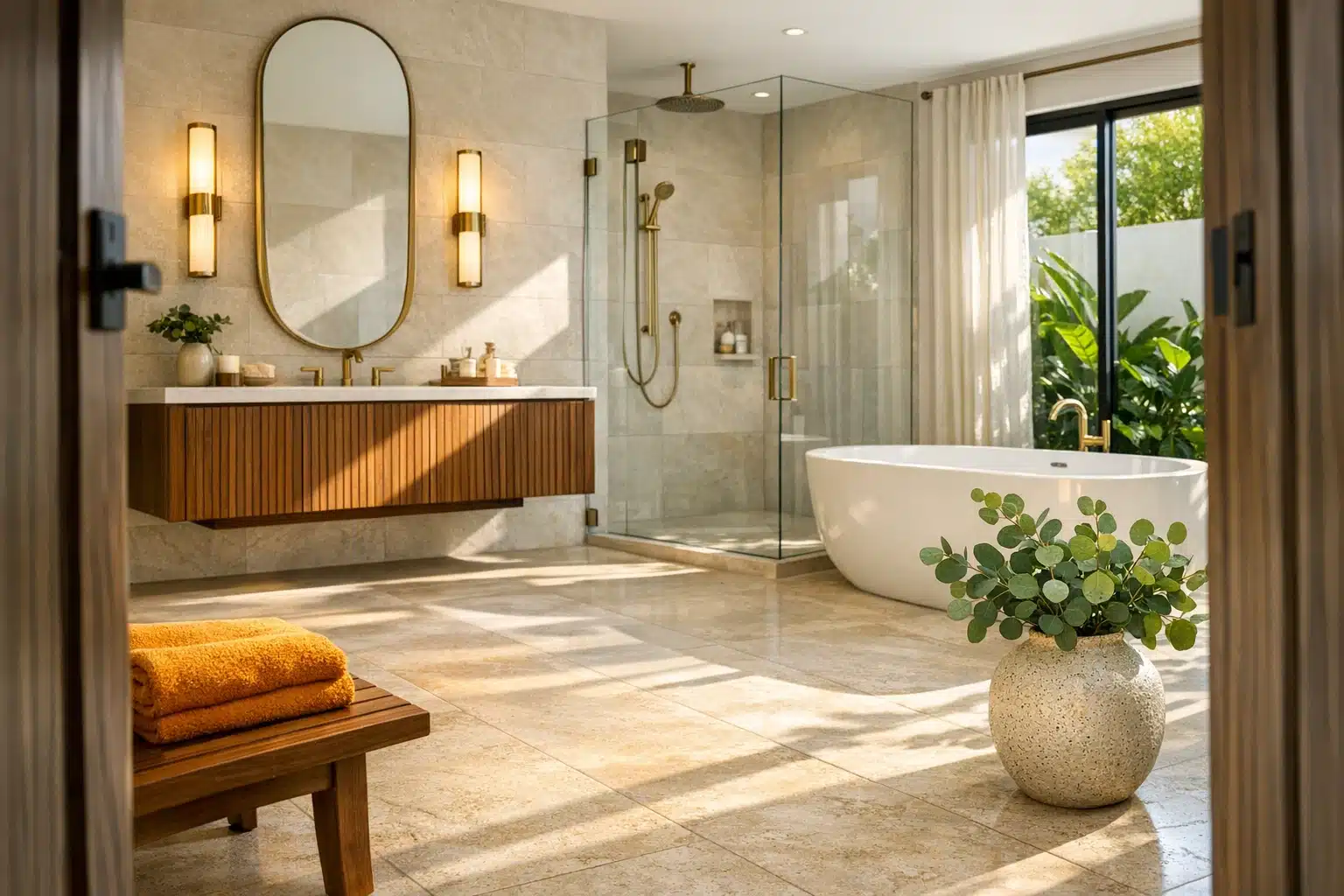
Another major trend is visual simplification. Clean-lined vanities, frameless glass, large-format tile, and concealed storage are all popular because they reduce visual clutter. That does not mean bathrooms have become cold or generic. In fact, warmer wood tones, brushed metal finishes, textured stone looks, and handmade-inspired tile are helping modern spaces feel more personal. The best remodels often balance sleek architecture with tactile elements, so the room reads as modern without feeling severe.
Wellness has also become a serious design influence. Heated floors, deeper soaking tubs, steam-ready showers, quieter fans, and improved acoustics are no longer limited to luxury custom homes. More midrange remodels now include features once considered indulgent because homeowners spend more time at home and want daily routines to feel less rushed. Transform your bathroom into a luxury home sanctuary with these expert-approved remodeling trends and design ideas. The phrase sounds aspirational, but the principle behind it is practical: if the space is comfortable, easy to clean, and designed around real habits, it works harder for the household every day.
Several trends are especially visible across new projects:
- Warm minimalism with matte finishes and soft natural colors
- Walk-in showers replacing underused tubs in primary bathrooms
- Floating vanities that visually open the floor area
- Improved ventilation systems for moisture control and air quality
- Water-efficient fixtures that reduce waste without sacrificing performance
These trends matter because bathroom remodeling is rarely cheap, and homeowners want renovations that will age well. According to remodeling industry reports, bathroom projects consistently rank among the updates with strong resale appeal, though returns vary by market and project scope. More importantly, the day-to-day value is immediate. A well-planned bathroom saves time, reduces stress, and supports long-term accessibility. In that sense, modern bath upgrades are not only about style. They are about making one of the hardest-working rooms in the home smarter, calmer, and more resilient.
2. Smarter Layouts and Renovation Ideas for Better Flow in Any Bathroom Size
Layout is where successful bathroom remodeling either takes shape or quietly falls apart. A room can feature beautiful tile, an elegant mirror, and expensive hardware, yet still feel awkward if the spacing is wrong. That is why designers typically begin with clearance, plumbing locations, door swings, and storage habits before discussing color palettes. Whether you are renovating a compact powder room or a spacious primary suite, the goal is to support movement naturally and make each zone feel intentional.
In smaller bathrooms, the most effective upgrades often come from removing friction rather than adding features. Replacing a bulky vanity with a slimmer cabinet, choosing a pocket or outswing door where appropriate, or switching from a shower curtain to clear glass can noticeably improve the sense of space. Large mirrors also help bounce light around the room, while wall-mounted faucets or toilets can free up valuable inches. In many urban homes and older properties, these small dimensional gains matter more than decorative changes.
For medium-sized family bathrooms, zoning becomes especially important. A common challenge is having one user at the sink while another needs access to the shower or toilet. Designers solve this by improving circulation paths and separating functions where possible. A double vanity may help, but not if it crowds the doorway or eliminates linen storage. In some cases, a single generous sink with more counter space and better drawer organization works better than two undersized basins. Thoughtful planning often beats feature stacking.
Larger bathrooms present a different issue: empty space can become wasted space if it lacks purpose. A freestanding tub placed without regard to walking paths may look dramatic in photos but feel inconvenient in daily use. Wide rooms often benefit from visual anchors such as a centered vanity wall, a framed wet-room shower zone, or a separate niche for dressing and storage. The best large bathrooms are not simply bigger; they are composed with rhythm, proportion, and practical intent.
When planning a renovation, homeowners should also think carefully about what to keep in place. Moving plumbing lines for toilets, tubs, or showers can increase labor and material costs significantly. If the current layout mostly works, refinements within the existing footprint may deliver stronger value than a complete rearrangement. This is especially true when budgets need to stretch across waterproofing, tile work, lighting, cabinetry, and ventilation.
Useful layout strategies include:
- Prioritize circulation widths around doors, vanities, and shower entries
- Use recessed niches and medicine cabinets to add storage without crowding the room
- Consider curbless or low-threshold showers for accessibility and visual continuity
- Place task lighting based on how the mirror is used, not just where the wiring already exists
- Choose vanity depth according to actual room scale rather than showroom trends
There is also a growing interest in future-ready design. Homeowners who intend to age in place often choose blocking for future grab bars, wider clearances, hand showers, and slip-resistant flooring during a remodel, even if they do not need every feature right away. This approach is smart because retrofitting later can be more disruptive and expensive. A good bathroom layout does not merely fit the room; it anticipates the rhythm of life in the years ahead. That blend of present comfort and long-term usability is what turns renovation ideas into meaningful home improvements.
3. Materials, Colors, and Finishes That Define Modern Bath Upgrades
Materials do much of the storytelling in a bathroom. They affect not only style but also maintenance, durability, moisture resistance, and the way light moves through the room. Modern bath upgrades are increasingly shaped by the search for surfaces that look refined while standing up to daily wear. This has led to a strong preference for porcelain tile, quartz countertops, performance paints, and easy-care metal finishes. Homeowners still love the look of natural stone and wood, but many now choose look-alike materials that deliver similar warmth with lower maintenance demands.
Porcelain remains one of the most versatile materials in contemporary bathrooms. It can mimic marble, limestone, concrete, terrazzo, or wood with impressive realism, and it generally performs well in wet environments. Large-format porcelain tile is especially popular because it reduces grout lines, which can make walls and floors feel calmer and easier to clean. That said, very large tiles require precise installation, and slip resistance should always be reviewed for floor use. Beautiful surfaces should never compromise safety.
Quartz has become a leading countertop option for vanities because it offers consistency, strength, and relatively simple care. Unlike some natural stones, it does not usually need regular sealing, making it attractive for busy households. For a softer visual effect, designers often pair quartz counters with wood-tone vanities, reeded panels, or painted cabinetry in muted shades. This combination helps prevent the room from feeling too glossy or sterile.
Color trends are also shifting. The all-white bathroom still has appeal, particularly for smaller spaces where brightness matters, but many current remodels introduce warmer neutrals such as sand, greige, mushroom, clay, and soft taupe. These tones create a more grounded atmosphere and work well with brushed brass, matte black, polished nickel, or bronze hardware. Deep greens, charcoal blues, and earthy terracotta accents are also appearing in powder rooms and statement walls, where homeowners feel freer to experiment.
Texture is another important design tool. Even restrained bathrooms benefit from contrast between smooth and tactile surfaces. A room might combine:
- Matte wall tile with a polished countertop
- Flat-front cabinetry with fluted or ribbed detail
- Simple slab tile with a mosaic niche or shower floor
- Warm metal hardware against cool stone-look surfaces
These contrasts add depth without requiring loud patterns or excessive decoration. They are especially effective in modern bathrooms, where the palette may be limited but the atmosphere still needs personality.
Finish selection should also respond to practical realities. Matte black fixtures can look striking, but they may show mineral spots depending on local water quality. Natural wood can add warmth, yet it needs proper sealing and good ventilation nearby. High-gloss cabinetry can reflect light well, but fingerprints may appear quickly in family bathrooms. The smartest material choices are not those that dominate social media boards; they are the ones that fit the way a home is actually used.
Ultimately, great bathroom finishes create cohesion. When floor tile, vanity style, countertop profile, mirror shape, and hardware finish work together, the space feels intentional rather than assembled piece by piece. That coherence is what makes modern bath upgrades appear polished, even when the budget is moderate. You do not need rare materials to achieve a strong result. You need materials that perform well, age gracefully, and support the mood you want the room to carry every morning and every night.
4. Technology, Lighting, and Water Efficiency: The Practical Side of Luxury
Some of the most valuable bathroom upgrades are not immediately visible in listing photos. Better ventilation, smarter lighting, efficient fixtures, and selected technology can dramatically improve the experience of using the space. These are the elements that make a bathroom feel quietly competent. When done well, they create comfort without calling attention to themselves, much like good hotel design where everything seems to work exactly when and how it should.
Lighting deserves special attention because bathrooms ask more of lighting than many other rooms do. People need bright, accurate task illumination at the mirror, comfortable ambient light for general use, and sometimes softer evening lighting to avoid glare. A single ceiling fixture rarely handles all three well. This is why layered lighting is now standard in many high-quality remodels. Vertical sconces beside the mirror often provide more flattering, shadow-reducing light than a lone fixture above it. Recessed ceiling lights can support overall brightness, while dimmers allow the room to shift mood across the day.
Ventilation is equally important, though frequently underestimated. Bathrooms produce humidity that can damage paint, promote mildew, and shorten the life of finishes if it is not removed effectively. Modern fans are quieter and more efficient than older models, and humidity-sensing options can improve performance by activating automatically when moisture rises. In tight or windowless bathrooms, this upgrade can protect the room as much as any surface choice.
Technology in bathrooms is also becoming more practical. Heated floors are a good example. They are often described as a luxury, but in colder climates they can improve comfort significantly and help tiles feel more inviting. Smart mirrors with integrated lighting, defogging features, and touch controls are appearing more often, though their value depends on the household. Digital shower controls, leak detectors, and bidet-integrated toilet seats are additional upgrades that may enhance convenience, hygiene, and water awareness.
Water efficiency continues to shape fixture design, especially as utility costs rise and sustainability becomes a stronger priority. Many modern faucets, showerheads, and toilets now meet efficiency standards without feeling underpowered. That marks a big improvement from early low-flow generations, which sometimes struggled with performance. Homeowners comparing products should review certified flow rates, flush technologies, and manufacturer support rather than assuming that all efficient fixtures behave the same way.
Useful upgrades to evaluate include:
- LED mirror lighting with high color accuracy for grooming
- Humidity-sensing exhaust fans for automatic moisture control
- Dual-flush or high-efficiency toilets to reduce water use
- Thermostatic shower valves for safer and more stable temperatures
- Leak detection sensors near vanities, tubs, and toilets
The idea of luxury has shifted here too. Increasingly, luxury means reliability, ease, and thoughtful environmental performance rather than ornament alone. A shower that heats quickly, lighting that flatters without strain, and a fan that runs quietly may matter more in real life than a decorative statement wall. When homeowners focus on these foundations, the bathroom becomes easier to maintain and more enjoyable to use. That is the practical side of modern design: beauty matters, but performance is what turns style into long-term satisfaction.
5. Budgeting, Project Planning, and How to Choose Upgrades That Last
A bathroom renovation can be exciting, but it also asks for disciplined planning. Between demolition, waterproofing, plumbing, electrical work, tiling, cabinetry, fixtures, labor, and permits, costs can rise quickly. That is why the most successful projects begin with priorities rather than product shopping. Homeowners should first decide what the renovation must solve. Is the room short on storage? Is the shower difficult to enter? Are surfaces outdated but still functional? Is there hidden moisture damage? Once those answers are clear, it becomes easier to allocate money where it will have the greatest impact.
One helpful way to think about budgeting is to divide decisions into three groups: must-have improvements, high-value enhancements, and optional splurges. Must-haves include infrastructure such as waterproofing, ventilation, plumbing repairs, electrical updates, and quality installation. These are not the glamorous parts of a remodel, but they protect everything else. High-value enhancements may include better lighting, durable countertops, efficient fixtures, improved storage, and a layout that functions more smoothly. Optional splurges could be radiant floor heating, custom shower glass, designer lighting, or specialty tile accents.
This framework matters because many projects become unbalanced. A homeowner may choose premium tile but underestimate labor complexity, or buy an expensive vanity before finalizing rough plumbing and clearances. In renovation work, sequence matters. The room is like a puzzle where hidden layers need to support visible choices. If the substrate, slope, waterproofing, or venting is compromised, even the most stylish finish package can fail.
Comparing quotes is another area where careful reading pays off. A lower estimate is not always a better estimate. Homeowners should ask what is included in demolition, disposal, surface preparation, tile setting materials, trim details, fixture installation, painting, and final punch-list work. It is also wise to confirm allowances. If a contract includes a modest tile allowance but the desired tile costs much more, the project budget may expand before work even begins. Transparency prevents frustration later.
When choosing where to spend and where to save, many professionals suggest the following:
- Spend on waterproofing, skilled labor, and durable plumbing fixtures
- Save with porcelain instead of some natural stones if maintenance is a concern
- Choose timeless core finishes and introduce trendier accents through mirrors, hardware, or paint
- Invest in storage solutions that reduce clutter and improve daily function
- Keep the existing footprint if it works well and major plumbing moves are unnecessary
Timelessness should not be mistaken for blandness. A bathroom can feel current without chasing every trend. The strongest remodels often combine one or two personality-driven elements with a calm, durable base. For example, a homeowner might choose a striking wall sconce or a bold vanity color while keeping tile and counters more neutral. This makes future updates easier and protects the renovation from looking dated too quickly.
For the target audience of homeowners, renovators, and design-conscious readers, the main lesson is simple: a better bathroom comes from better decisions, not just bigger spending. When layout, materials, lighting, ventilation, and budget strategy are aligned, the result is a room that performs well and feels rewarding every day. Modern bathroom remodeling is ultimately about living better at home, with upgrades that support both present comfort and long-term value.